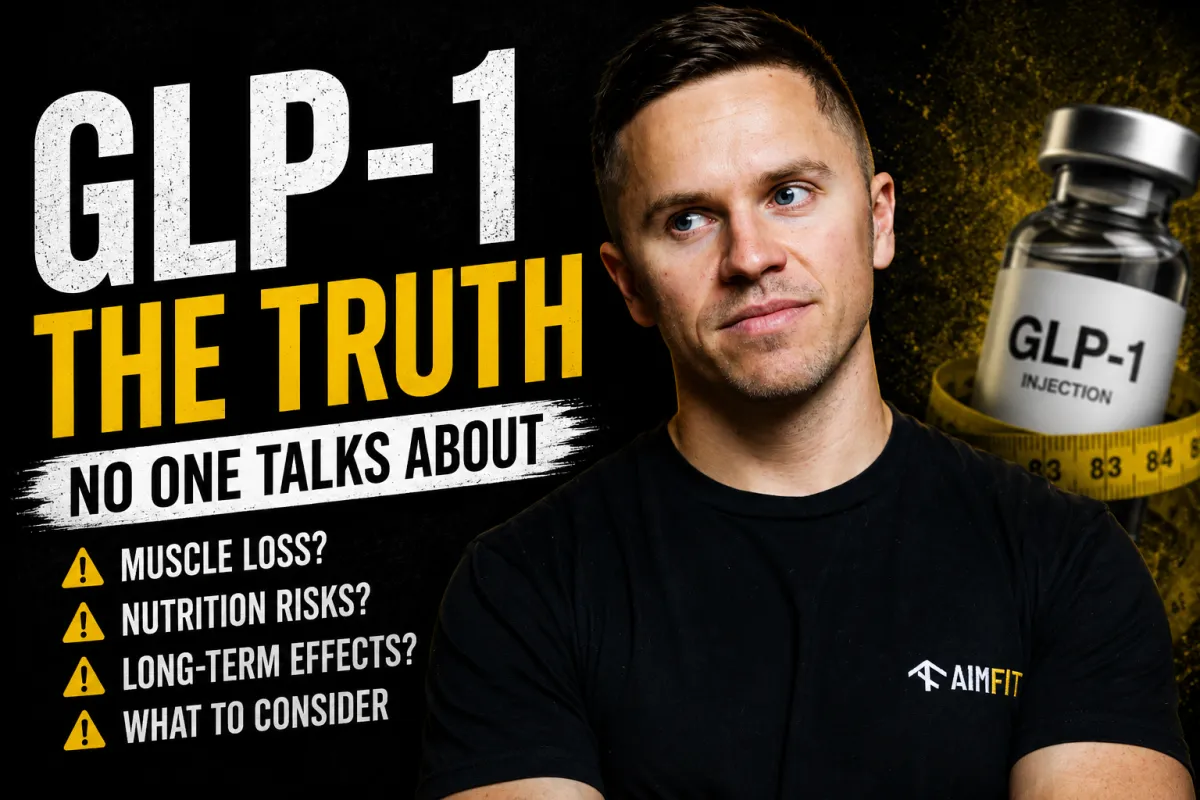
Ozempic's Weight Loss Risks & Better Alternatives
Health, Weight Loss, Ozempic, GLP-1s, AIMFIT
⚠️Not medical advice. Consult your doctor before making decisions about any medication. I'm a coach, not a physician. ⚠️
My client went to her family doctor to request blood tests to figure out why she was struggling with weight loss. She came back with a prescription for 2 different kinds of glp-1s.
Oral and Injectable.
This was back in 2022 when I was first exposed to the prescription of these drugs for the people I was working with.
I started learning about how often drugs like Ozempic and Mounjaro were being prescribed for weight loss.
Did you know that roughly 1/10 canadians use GLP-1s?
https://www.cbc.ca/news/health/canadians-glp1-ozempic-mounjaro-9.7114197
Seems like a lot, right?
Out of interest I started reading research studies to learn how the drug works, it’s safety, efficacy, and long term effects.
What I read surprised me.
And I started becoming concerned when the symptoms were lining up with my client’s anecdotal experiences.
Especially, because no one using the drugs even understood how they worked.
I value teaching my clients why I’m giving them exercises so that they understand how what they are doing will either increase strength, build muscle, and reduce joint pain.
So if they are taking drugs without understanding why, I encourage them to ask their doctor how it works.
So what do GLP-1s even do?
Well here’s a simple description:
It affects your pancreas to release insulin (which lowers blood sugar) and reduces glucagon (which normally raises blood sugar). This is why GLP-1 drugs help with diabetes.
It also affects your stomach and how fast food empties out. You feel full longer because food just sits there digesting more slowly.
And with your brain, it acts on appetite centers (specifically the hypothalamus) to reduce hunger signals and increase feelings of fullness. This is the big driver of weight loss.
The drugs (semaglutide/Ozempic/Wegovy, tirzepatide/Mounjaro/Zepbound, etc.) are lab-made versions of this hormone (which we produce naturally), but engineered to stick around in your body for days instead of minutes like the natural hormone does. That's why it's a once-weekly shot. It's mimicking GLP-1 but with way more staying power.
Now, I do understand that obesity is a problem in Canada, and other countries. I don’t need to go too indepth describing its impact so here’s a good article that covers it. https://madeinca.ca/obesity-statistics-canada/
So I get the, “Well if I take ozempic, that’s better than type 2 diabetes, heart disease and different kinds of cancers” My response is “I guess…. “
But there are a host of problems. I’ll get into 3 of them to keep this sort of short…
#1 - Common side effects; Nausea, vomiting, diarrhea, and constipation are the most frequently reported adverse events across GLP-1RA drugs.
#2 - Lowering your metabolic rate. A study published in 2024 (https://dom-pubs.onlinelibrary.wiley.com/doi/10.1111/dom.15728) found that 40-65% of the weight lost was LEAN MASS which includes;
Skeletal muscle, Organs, Bone, and Body water/fluids… and I’m not a doctor but I’m pretty sure those are important. HOWEVER, it is NORMAL to lose some muscle mass when you lose total mass because your body does not require the same amount of muscle to keep you standing and moving around. which is why exercise is important to maintain muscle mass. But this is worth considering. Which is why it’s hard to determine how much of the muscle mass loss is adaptive or maladaptive.
#3 - Psychiatric effects (emerging, unresolved). Some of the clients I’ve worked with have shared some anecdotal experiences with me. I have found a couple articles that back up their experiences BUT I think it's important that I first include the warning thingy here:
⚠️Not medical advice. Consult your doctor before making decisions about any medication. I'm a coach, not a physician. ⚠️
Ok so now that I’ve shared that here’s what is included in this study that was conducted over 8 years with 160 thousand control patients https://www.nature.com/articles/s41598-024-75965-2 / https://doi.org/10.1038/s41598-024-75965-2
You can read the article itself but mentions a few things like;
“ the study included 162,253 case and control patients. This study showed a significant association between GLP-1 RA treatment and an 98% increased risk of any psychiatric disorders. Notably, patients on GLP-1 RAs exhibited a 195% higher risk of major depression, a 108% increased risk for anxiety, and a 106% elevated risk for suicidal behavior.”
And
“While preclinical studies, primarily in animal models17,18, suggest a potential beneficial effect of GLP-1 RAs on mood and behavior, the clinical evidence in humans remains unclear”
Now I could be wrong but there seems to be some red flags.
So you can probably guess what happens when the symptoms become too much to bear and you finally decide to start coming off of a drug that ;
Decreases metabolic rate
Decreases hunger
Increases insulin secretion
And slows digestion…
Except you don’t have to guess and ill link an article here https://www.bmj.com/content/392/bmj-2025-085304 https://doi.org/10.1136/bmj-2025-085304
“cessation of WMM is followed by rapid weight regain and reversal of beneficial effects on cardiometabolic markers.”
Simply put, weight gets put back on, and health metrics go back to bad.
Again……. This is:
⚠️Not medical advice. Consult your doctor before making decisions about any medication. I'm a coach, not a physician. ⚠️
What I would absolutely encourage you to do is take small steps to exercising a bit more, eating a bit cleaner, and try to get into a consistent routine.
And if you need help… you can reach out to me for safe exercise, a meal plan made with the foods you are already familiar with, and on-going support.
A coach that genuinely cares about his client’s success;
Aaron